Difference between revisions of "MPLab1 Addition"
Jump to navigation
Jump to search
| Line 29: | Line 29: | ||
[[File:Lex.png|center| Running Lex Programs ]] | [[File:Lex.png|center| Running Lex Programs ]] | ||
| − | ==The | + | ==The Assembly Program Structure== |
| − | + | An assembly program is separated into three sections as follows: <br><br> | |
| − | + | <pre> | |
| − | + | .MODEL SMALL | |
| − | + | .STACK 100h | |
| − | + | </pre> | |
| − | + | <pre> | |
| − | + | .DATA | |
| − | < | + | ;data definition go here |
| − | + | </pre> | |
| − | + | <pre> | |
| − | + | .CODE | |
| − | + | ;instructions go here | |
| − | + | </pre> | |
| − | |||
| − | < | ||
| − | |||
| − | |||
Revision as of 00:07, 18 September 2023
32-bit Binary Addition Step by Step
1. Specify the memory model for code, data, and stack segments
.model small
.stack 100H
2. Define your data in the data section ( here you can define various data items: variables, constants, strings, arrays)
.data                           ; .data directive indicates the beginning of data section
data1 dd 00H
num1 db 10,13,"Enter the first number: $"
num2 db 10,13,"Enter the second number: $"
sum db 10,13,"The sum is :$"
3. Define your instruction in the code section (here you write the assembly instructions that perform computations, control program flow, and interact with data variables and memory)
.code                           ; .code directive indicates the beginning of code section
.startup                        ;  the entry point of the program

MOV EBX, 00000000
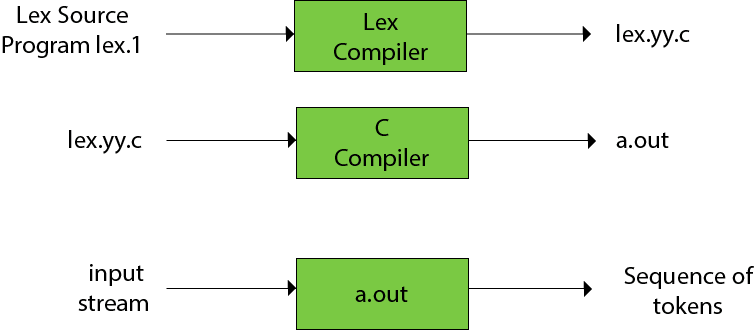
The function of Lex is as follows:
- Firstly lexical analyzer creates a program lex.l in the Lex language. Then Lex compiler runs the lex.l program and produces a C program lex.yy.c.
- Finally C compiler runs the lex.yy.c program and produces an object program a.out.
- a.out is lexical analyzer that transforms an input stream into a sequence of tokens.

The Assembly Program Structure
An assembly program is separated into three sections as follows:
.MODEL SMALL
.STACK 100h
.DATA
;data definition go here
.CODE
;instructions go here
